The Musical Devotion of Radha and Krishna in Mural Art
June 25, 2026Admin
READING
The Musical Devotion
of Radha and Krishna in Mural Art
Delve into the intricate symbolism and rhythmic grace of a classic Kerala mural painting depicting the divine romance of Radha and Krishna through celestial music.
Conversation with Gemini
i have a website as kerala art gallery , there will upload the arts and the drawings , then there will need upload images in the blog page , so i will share the create form , and the images and its category, when i sharing the images ,analyse that image and give me those details to create it based on the attatched create form fileds - so see the attached screenshot of the form
Got it! I have analyzed the "Blog Settings" create form fields provided across image_20a887.png and image_20a8a7.png.
Whenever you share an art piece, drawing, or photograph along with its general category, I will map the details exactly to your website's form fields. Here is the structure I will use to generate your content:
Title: A catchy, relevant title for the blog post.
Excerpt: A brief, 1–2 sentence summary to display on the main blog feed.
Category: The specific type of art (e.g., Mural Painting, Kathakali Art, Charcoal Drawing, Landscape).
Content:
Introduction: A paragraph opening up the topic and setting the context.
Section 1 (Heading & Body Text): A specific look into the technique, history, or mood of the piece.
(Additional sections as needed to provide rich context)
Author: (Typically defaulted to Admin, but can customize if needed).
Cover Image: (Where you'll upload or link your artwork).
Visibility / Featured Post Status: Recommended settings.
Go ahead and drop your first image and any context or category details you have! I'll turn it into a complete, ready-to-copy blog entry.
mural work
Here are the blog post details mapped exactly to your form fields, based on the stunning traditional mural work shown in 20180204_100032.jpg.
Title
The Divine Colors of Kerala: Traditional Mural Art in Sacred Spaces
Excerpt
A captivating look into the vibrant world of traditional Kerala mural paintings, exploring how these ancient, spiritually charged artworks beautifully adorn and bring life to sacred temple architecture.
Category
Mural Painting
Content
INTRODUCTION
Kerala mural paintings are a glorious testament to the region’s rich cultural and artistic heritage, dating back several centuries. Characterized by their vivid organic pigments, elaborate linework, and highly stylized depictions of deities, these murals traditionally bring temple walls to life with divine narratives. As seen in 20180204_100032.jpg, these masterpieces bridge the gap between ancient mythology and architectural beauty, offering devotees and art lovers a visual gateway to the spiritual realm.
SECTION 1
Section heading: The Symbolism and Aesthetics of Temple Murals
Section body text: Traditional Kerala murals rely on a specific color palette dictated by custom—primarily using five natural colors (Panchavarna): red, saffron, yellow, green, and black. Each hue carries profound symbolic meaning; for instance, the stylized green tones often represent Satwika (pious or divine) qualities, while deep blues and fiery reds depict cosmic power and dynamic energy. Placed prominently at the temple threshold, as showcased in the accompanying image, these framed mural works create a powerful visual harmony with the laterite stone structure, enhancing the sacred ambience with their timeless warmth and rhythmic grace.
Author
Admin
Visibility
[x] Public for everyone
Featured Post
[ ] (Optional: Check this if you want it on your homepage!)
Here are the blog post details mapped exactly to your form fields for the canvas mural painting shown in 20180803_100637-1.jpg.
(Note: The image is sideways, but it beautifully captures the divine love of Radha and Krishna on a swing beneath a tree.)
Title
Radha Krishna on a Swing: The Poetic Grace of Kerala Mural Art
Excerpt
Discover the stylized romance and intricate linework of a classic Kerala mural canvas painting, depicting the divine love of Radha and Krishna amidst nature.
Category
Mural Painting
Content
INTRODUCTION
The divine romance of Radha and Krishna has inspired countless artistic traditions across India, but few capture its rhythmic movement and vibrant warmth quite like Kerala’s mural style. In 20180803_100637-1.jpg, we see this timeless theme beautifully adapted onto canvas. The artwork portrays the divine couple sharing a serene moment on a decorative swing (Oonjal), surrounded by stylized elemental motifs of swirling water, lush trees, and delicate flora that are signature hallmarks of this coastal art form.
SECTION 1
Section heading: Rhythmic Linework and the Panchavarna Palette
Section body text: This piece brilliantly showcases the signature technical elements of Kerala murals, particularly the focus on shading through dotting (Stippling) and bold outlines that give the divine figures their striking dimensionality. Krishna is depicted in his iconic deep blue skin tone (Shyamavarna), perfectly contrasted against the warm golden-yellow hues of Radha. The stylized waves on the border and the intricate detailing of their traditional ornaments bring a powerful sense of flow and movement to the canvas, bounded neatly by an elegant black-and-white floral patterned border.
Author
Admin
Visibility
[x] Public for everyone
Featured Post
[ ] (Optional: Check this if you want it on your homepage!)
Here are the blog post details mapped exactly to your form fields for the canvas mural painting shown in 20180817_092041.jpg.
Title
The Beauty of the Royal Court: Goddess Parvati and Her Attendants in Kerala Murals
Excerpt
Explore a masterful depiction of divine grace, featuring a central green-hued goddess surrounded by her attendants, rendered with the striking complexity and warmth of the traditional Kerala mural style.
Category
Mural Painting
Content
INTRODUCTION
In the traditional art of Kerala, mural canvas paintings often recreate magnificent assembly scenes or royal court setups from classical epics. The painting captured in 20180817_092041.jpg showcases an exquisite gathering centered around a divine queen or goddess—likely Goddess Parvati—seated elegantly on a golden throne. She is framed beautifully by a series of female attendants (Sevikas), each captured in a unique posture, holding mirrors and offerings, highlighting the narrative richness and symmetry central to this ancient art form.
SECTION 1
Section heading: Detailed Ornamentation and Character Expressions
Section body text: What makes this canvas masterpiece stand out is its flawless execution of dense composition. The central figure is painted in a soothing green tone (Satwika aspect), while her handmaidens alternate between ochre yellow and pristine white skin tones to create a balanced, captivating contrast. Every character is heavily adorned with elaborate crowns (Mugalan), traditional neckpieces, and ornate wristlets. The fluid curves, expressive fish-shaped eyes, and the intricate black-and-white circular pattern on the outer border work together seamlessly to pull the viewer into this majestic, timeless spiritual gathering.
Author
Admin
Visibility
[x] Public for everyone
Featured Post
[ ] (Optional: Check this if you want it on your homepage!)
Here are the blog post details mapped exactly to your form fields for the stunning nature-themed canvas mural painting shown in 20180920_092541.jpg.
Title
Harmonies of Nature: The Wild and Serene Landscape in Kerala Mural Art
Excerpt
Step into a vibrant, stylized wilderness where elephants, deer, and peacocks thrive along a rushing river, beautifully brought to life through traditional Kerala mural techniques.
Category
Mural Painting
Content
INTRODUCTION
While traditional Kerala mural art is widely celebrated for its portraits of divine figures, it also holds a deep reverence for the natural world. In 20180920_092541.jpg, we see a magnificent canvas painting that turns its full attention to a lush, mythical wilderness. The scene depicts a serene landscape teeming with wildlife: elephants interacting by a riverbank, spotted deer resting beneath stylized trees, peacocks perched high in the branches, and a snow-capped mountain rising in the background. It highlights how seamlessly the mural form can capture the sprawling beauty of Mother Earth.
SECTION 1
Section heading: Stylized Elements and Flowing Landscapes
Section body text: This artwork is an exceptional showcase of how nature is stylized within the mural tradition. The rushing river is depicted using rhythmic, tightly wound blue and white curls, dotted with blossoming pink lotuses and swimming waterfowl. The trees are painted with twisted, golden-ochre trunks and intricately layered green foliage, balancing the bright saffron and warm orange hues of the sky. Framed by a classic black-and-white geometric border, this painting beautifully illustrates the core philosophy of Kerala murals—where every element of nature is treated with the same meticulous detail, warmth, and grace as a divine deity.
Author
Admin
Visibility
[x] Public for everyone
Featured Post
[ ] (Optional: Check this if you want it on your homepage!)
Here are the blog post details mapped exactly to your form fields for the canvas mural painting shown in 20180921_091226_Burst01.jpg.
Title
The Eternal Swing: Divine Love of Radha and Krishna in Kerala Mural Style
Excerpt
An intimate exploration of a canvas mural masterpiece depicting Radha and Krishna on a ceremonial swing, surrounded by the vibrant, rhythmic elements of traditional Kerala art.
Category
Mural Painting
Content
INTRODUCTION
The depiction of Lord Krishna and his eternal consort Radha sharing a tender moment on a swing (Oonjal) is one of the most beloved motifs in Indian classical art. In 20180921_091226_Burst01.jpg, this celestial theme is rendered with the strict geometric discipline and stylistic fluidness unique to Kerala's mural tradition. Seated together beneath a canopy of dense, stylized trees, the divine couple exude a sense of profound serenity and cosmic balance, bringing an ancient scriptural romance directly to life on canvas.
SECTION 1
Section heading: Expressive Postures and Naturalistic Motifs
Section body text: This artwork beautifully highlights the Panchavarna color system, contrasting Krishna’s tranquil cerulean blue skin tone with Radha’s radiant golden-ochre hue. Both figures feature the characteristic elongated, fish-shaped eyes (Meenakshi) that convey deep emotion. The composition is highly dynamic; the ropes of the swing drape elegantly into the hands of the deities, while the lower portion of the canvas transitions into stylized frothing waves teeming with golden fish. Birds like peacocks and parrots rest quietly in the branches above, framed beautifully against a warm, glowing saffron sky that gives the entire piece an ethereal aura.
Author
Admin
Visibility
[x] Public for everyone
Featured Post
[ ] (Optional: Check this if you want it on your homepage!)
Here are the blog post details mapped exactly to your form fields for the large panoramic mural painting shown in 1490077836841.jpg.
Title
Bringing Tradition Home: Transforming Contemporary Spaces with Panoramic Kerala Murals
Excerpt
Discover how large-scale, traditional Kerala mural canvases can serve as stunning statement pieces, bridging ancient heritage with modern interior design.
Category
Mural Painting
Content
INTRODUCTION
While traditional Kerala murals originally adorned the vast expanses of temple walls, modern canvas adaptations allow this magnificent art form to grace contemporary living spaces. In 1490077836841.jpg, we see a brilliant example of a large, panoramic mural canvas framed and mounted as a central masterpiece in a modern home. This wide horizontal format offers an incredible canvas for complex, unfolding mythological narratives, completely transforming the ambiance of the room with its vibrant warmth and cultural depth.
SECTION 1
Section heading: Grand Narratives and Interior Elegance
Section body text: The painting showcased here features a highly detailed, continuous narrative—likely depicting stories from the Krishna Leela or celestial forests—filled with stylized figures, divine entities, and lush nature motifs. Dominated by a fiery saffron background, the dense composition draws the eye across the wall, creating a captivating focal point. Incorporating such a massive traditional artwork into minimal or neutral modern interiors showcases how ancient colors and stylized forms can beautifully coexist with contemporary architecture, acting as a living testament to heritage.
Author
Admin
Visibility
[x] Public for everyone
Featured Post
[ ] (Optional: Check this if you want it on your homepage!)
Here are the blog post details mapped exactly to your form fields for the closer look at the expansive horizontal mural artwork shown in 1490077837765.jpg.
Title
The Art of Narrative Panoramas: Deciphering Stories in Kerala Mural Canvases
Excerpt
Dive into the layered storytelling and masterful compositional structure of a wide horizontal Kerala mural painting custom-fit for interior design.
Category
Mural Painting
Content
INTRODUCTION
A hallmark of masterful Kerala mural painting is the ability to sustain visual interest across an immense, continuous space without losing detail or emotional weight. In 1490077837765.jpg, a closer view of the panoramic canvas shows how multiple episodes from classical lore can be woven into a single, breathtaking frame. Moving the eye from left to right, viewers are treated to an unfolding journey populated by divine forms, playful animals, and stylized nature, all working together to form a rich narrative tapestry.
SECTION 1
Section heading: Compositional Flow and the Illusion of Motion
Section body text: In a panoramic layout like this one, the artist utilizes natural anchors—such as the central stylized tree canopy and rolling clouds—to separate distinct sub-scenes without rigid borders. On the far left, standing deities establish a calm, grounding presence, which transitions into a highly dynamic middle and right section filled with gopis, worshippers, and expressive gestures. The background, saturated with traditional vermilion and saffron hues, unifies the entire length of the canvas, proving that ancient temple proportions can be successfully re-engineered to bring balance and dramatic character into modern spaces.
Author
Admin
Visibility
[x] Public for everyone
Featured Post
[ ] (Optional: Check this if you want it on your homepage!)
Here are the blog post details mapped exactly to your form fields for the canvas mural painting shown in 1490078105732.jpg.
(Note: The image is sideways, but it captures a beautiful, detailed depiction of Lord Ganesha in the traditional Kerala mural style.)
Title
Lord Ganesha: The Divine Remover of Obstacles in Kerala Mural Art
Excerpt
Delve into the magnificent form of Lord Ganesha, rendered with vibrant golden-ochre tones and intricate ornamentation unique to classical Kerala mural iconography.
Category
Mural Painting
Content
INTRODUCTION
Lord Ganesha, the deity of wisdom and prosperity, is a deeply revered subject in Indian classical art. In 1490078105732.jpg, we see a striking canvas mural that captures Ganesha in his majestic, multi-armed form. Adhering closely to traditional iconographic rules, the painting brings out the deity’s gentle yet powerful presence through bold lines, meticulous shading, and a warm color palette that reflects the artistic spiritual heritage of Kerala.
SECTION 1
Section heading: Iconography, Color Mastery, and Dense Borders
Section body text: The painting prominently features a rich golden-yellow and saffron hue for Lord Ganesha’s form, balanced by subtle green accents on his garments. He is surrounded by smaller figures of musicians, worshippers, and celestial attendants tucked seamlessly into the background, which creates a sense of continuous celebration around the deity. The exquisite linework on his trunk, crown (Kireetam), and jewelry displays the signature stippling (dot-shading) technique. Bounded by an elegant, repeating black-and-white floral patterned border, this piece perfectly showcases the artistic harmony that makes Kerala murals so visually captivating.
Author
Admin
Visibility
[x] Public for everyone
Featured Post
[ ] (Optional: Check this if you want it on your homepage!)
Here are the blog post details mapped exactly to your form fields for the large wall-mounted mural painting shown in Anjali Ayurvedics,Kannur.jpg.
Title
Sacred Aesthetics: Traditional Kerala Mural Art in Wellness Spaces
Excerpt
Explore how a grand, detailed Kerala mural painting brings a sense of serenity, cultural heritage, and timeless beauty to contemporary wellness and healing centers.
Category
Mural Painting
Content
INTRODUCTION
The ancient art forms of Kerala share a deep root with wellness, balance, and classical heritage. In Anjali Ayurvedics,Kannur.jpg, we see a magnificent example of a large-scale traditional canvas mural prominently integrated into an architectural space. Set against a rustic, exposed brick wall, this extensive horizontal composition depicts an assembly of divine figures—including a central seated goddess or deity flanked by celestial attendants—instantly transforming a modern corridor into a space filled with spiritual energy and calmness.
SECTION 1
Section heading: Harmony of Color and Texture in Interior Spaces
Section body text: This particular piece beautifully exemplifies the classic Panchavarna (five-color) scheme, using a dominant warm palette of saffron, golden yellow, and deep orange tones that perfectly complement the natural brickwork. The use of vibrant green skin tones for prominent divine entities signifies their serene and noble attributes. Accompanied by meticulous stippling work for shading and a classic white-on-black decorative border, this installation demonstrates how traditional art adds texture, warmth, and a distinct cultural character to commercial or residential healing environments.
Author
Admin
Visibility
[x] Public for everyone
Featured Post
[ ] (Optional: Check this if you want it on your homepage!)
Here are the blog post details mapped exactly to your form fields for the canvas mural painting shown in DSC_0008.jpg.
Title
The Sacred Wedding: Lord Krishna and Rukmini’s Celestial Vivaha in Kerala Mural Style
Excerpt
Step into an intricate, divine gathering featuring Lord Krishna and his consort amidst sages, deities, and stylized fire motifs, captured through the dense brilliance of traditional Kerala mural art.
Category
Mural Painting
Content
INTRODUCTION
Mythological marriages and grand assembly scenes have always demanded the highest level of detail from classical artists. In DSC_0008.jpg, we witness a stunning canvas painting portraying a celestial wedding ceremony—most likely the sacred union (Vivaha) of Lord Krishna and Rukmini. The canvas is densely packed with divine onlookers, attendant deities, and a revered white-bearded sage (resembling Sage Narada or a chief priest) overseeing the ceremony, creating an atmosphere of immense cosmic celebration and grandeur.
SECTION 1
Section heading: The Agni Sakshi and Masterful Stippling Details
Section body text: At the very heart of the composition sits a serene, blue-hued Lord Krishna alongside his consort on an elevated dais, right above a stylized sacrificial fire altar (Homa Kunda or Agni Sakshi). The flames are rendered using rhythmic, clean orange and white peaks characteristic of the art form. Surrounding them are multiple figures painted in a balanced mix of golden-ochre and soft green skin tones. The entire background is seamlessly woven together with sweeping floral vines, dynamic gestures, and meticulous dot-shading (stippling). Wrapped inside the classic white wheel-and-black border pattern, this magnificent piece exemplifies the sheer depth and storytelling power of Kerala's heritage paintings.
Author
Admin
Visibility
[x] Public for everyone
Featured Post
[ ] (Optional: Check this if you want it on your homepage!)
Here are the blog post details mapped exactly to your form fields for the architectural frieze mural shown in IMG_2370 - Copy.jpg.
Title
Stories in the Sky: Traditional Kerala Mural Friezes and Temple Architecture
Excerpt
Explore how long horizontal border murals, known as friezes, narrate classic mythological tales like the playful antics of Lord Krishna to elevate interior and temple spaces.
Category
Mural Painting
Content
INTRODUCTION
In traditional Kerala architecture, every available surface above eye level serves as a canvas for the divine. Frieze paintings—long, continuous horizontal panels typically positioned just below the ceiling—are designed to take viewers on a visual, chronological journey through sacred lore. As captured in IMG_2370 - Copy.jpg, this beautiful installation seamlessly flows along the upper wall border, turning an architectural beam into an unfolding storyboard of classical stories and legendary playfulness.
SECTION 1
Section heading: The Playful Tales of Balakrishna and Celestial Vahanas
Section body text: This particular horizontal mural beautifully captures the playful spirit of Lord Krishna's childhood stories (Krishna Leela). Near the center, a well-loved narrative unfolds: the young, blue-hued Krishna is depicted stealing butter, cleverly climbing onto the back of a friend who is down on all fours to reach a hanging butter pot (Uri). To the right, another distinct panel showcases a green-complexioned deity majestically riding a white swan (Hamsa), surrounded by billowing golden clouds and floral creepers. By utilizing the classic Panchavarna palette against the natural warmth of wooden paneling below, this style of layout highlights how narrative rhythm and architectural design merge perfectly in the Kerala tradition.
Author
Admin
Visibility
[x] Public for everyone
Featured Post
[ ] (Optional: Check this if you want it on your homepage!)
Here are the blog post details mapped exactly to your form fields for the canvas mural painting shown in IMG_2657.jpg.
Title
The Fierce Grace of Bhadrakali: Iconography in Kerala Mural Paintings
Excerpt
Discover the powerful and protective form of Goddess Bhadrakali standing within a sanctum aura, masterfully captured through traditional Kerala mural proportions and natural color shading.
Category
Mural Painting
Content
INTRODUCTION
Goddess Bhadrakali holds a deeply prominent position in the spiritual fabric and folklore of Kerala. In IMG_2657.jpg, we see a magnificent canvas mural that isolates the goddess as the supreme focal deity, replicating the layout of a sanctum sanctorum (Sreekovil). Standing proudly on a pedestal, the multi-armed goddess is surrounded by sacred ritual elements—including hanging temple lamps (Thookkuvilakku) and floor lamps (Nilavilakku)—recreating the solemn, powerful energy of a traditional shrine.
SECTION 1
Section heading: Iconic Weapons, the Prabhavali, and Color Contrast
Section body text: The artwork showcases the goddess in a serene yet powerful blue-green skin tone (Satwika-Raajasika blend), carrying weapons like the curved sword (Vaal) and the shield. She stands framed by a massive, highly detailed golden-orange archway or aura (Prabhavali), which acts as a vibrant backdrop to her detailed jewelry, heavy crown, and draped red attire. What sets this painting apart compositionally is the use of a crisp, sky-blue background behind the archway, providing a modern breathing space that makes the fiery traditional palette of the central icon stand out dramatically.
Author
Admin
Visibility
[x] Public for everyone
Featured Post
[ ] (Optional: Check this if you want it on your homepage!)
Here are the blog post details mapped exactly to your form fields for the large-scale cultural mural canvas shown in IMG_3248 copy.jpg.
Title
The Spirit of Pooram: Celebrating Kerala's Iconic Temple Festivals in Mural Art
Excerpt
Experience the grand rhythmic energy of a Kerala temple festival—complete with caparisoned elephants and traditional percussion ensembles—immortalized on a panoramic mural canvas.
Category
Mural Painting
Content
INTRODUCTION
Few events capture the soul, rhythm, and colors of Kerala quite like its magnificent temple festivals, or Poorams. In IMG_3248 copy.jpg, this explosive cultural energy is brought indoors through a massive, panoramic mural canvas. Spanning nearly an entire living room wall, the artwork acts as a stunning cultural gateway, depicting the multi-layered celebration of a temple festival in the signature stylized language of traditional Kerala murals.
SECTION 1
Section heading: Capturing Caparisoned Elephants and Panchavadyam Rhythm
Section body text: The canvas layout brilliantly captures the sensory overload of a festival. On the left, a traditional percussion ensemble (Panchavadyam or Chenda Melam) is shown in dynamic motion, their arms raised mid-beat. Beside them, majestic caparisoned elephants carrying the sacred deity idol (Thidambu) stand tall under the shade of stylized trees and festive fireworks. The center of the canvas leads the eye toward a traditional Kerala temple structure (Ambalam), surrounded by rows of thousands of devotees rendered in warm ochre, saffron, and rich terracottas. Framed in elegant dark wood that matches the home's crown molding, this installation demonstrates how mural art can archive a community's deep-rooted living traditions on a modern scale.
Author
Admin
Visibility
[x] Public for everyone
Featured Post
[ ] (Optional: Check this if you want it on your homepage!)
Here are the blog post details mapped exactly to your form fields for the sacred home decor installation shown in IMG_3790.jpg.
Title
The Sacred Foyer: Designing a Traditional Pooja Corner with Kerala Mural Art
Excerpt
See how a radiant, circular Ganesha mural canvas serves as the spiritual centerpiece for a modern home entry, creating an inviting aura of peace and prosperity.
Category
Mural Painting
Content
INTRODUCTION
First impressions set the tone for a home, and incorporating traditional art into a foyer or entrance hall can establish an immediate sense of peace and cultural grounding. In IMG_3790.jpg, we see a beautifully designed interior pooja and meditation corner. The area features a stunning, square-framed Kerala mural canvas of Lord Ganesha positioned prominently on the wall, paired thoughtfully with a classic standing Krishna idol, brass lamps (Nilavilakku), and a patch of indoor green turf to cultivate a tranquil, sacred sanctuary.
SECTION 1
Section heading: The Radiant Mandala and Traditional Accents
Section body text: The focal point of this installation is the unique composition of the mural. Unlike dense, full-canvas narratives, this artwork features a multi-armed Lord Ganesha enclosed within a beautiful, circular sunburst mandala or Prabhavali. Painted in rich saffron, golden-yellow, and bright blue tones, the circular design radiates outward against a brilliant solid yellow background, naturally drawing positive energy to the space. Encased in a heavy dark wood frame, it acts as the perfect spiritual anchor for the brass lamps and traditional artifacts beneath it, demonstrating how ancient mural geometry can be seamlessly adapted into modern home aesthetics.
Author
Admin
Visibility
[x] Public for everyone
Featured Post
[ ] (Optional: Check this if you want it on your homepage!)
Here are the blog post details mapped exactly to your form fields for the canvas mural painting shown in IMG_7358.jpg.
(Note: The image is sideways, but it captures a magnificent depiction of Lord Krishna playing his flute alongside a female companion playing a stringed instrument, likely Radha or a Gopi.)
Title
The Divine Symphony: Krishna’s Flute and the Melodies of Kerala Mural Art
Excerpt
Discover the rich musical imagery and expressive symbolism of a traditional Kerala mural canvas, where Lord Krishna and his companion harmonize amidst a sea of fiery terracotta hues.
Category
Mural Painting
Content
INTRODUCTION
Music and divinity are deeply intertwined in Indian classical lore, providing a timeless source of inspiration for traditional painters. In IMG_7358.jpg, this celestial harmony is beautifully brought to life on canvas through the classical guidelines of Kerala mural painting. The artwork depicts a green-hued Lord Krishna gracefully holding his flute (Venu) to his lips, standing alongside a companion who gently cradles and plays a traditional stringed instrument. Together, they create a visual symphony that radiates grace, devotion, and a deep spiritual rhythm.
SECTION 1
Section heading: The Satwika Green Profile and Flowing Elements
Section body text: This masterpiece highlights the deep symbolic language of the traditional Panchavarna color system. Lord Krishna is rendered in a profound, earthy green tone, traditionally used to signify Satwika—divine, noble, and calm characteristics. In beautiful contrast, his companion is painted with soft ochre-white skin tones, dressed in garments of vibrant green and orange. Their elongated, expressive eyes capture a look of serene focus, while the background is filled with swirling golden ornaments, stylized floral vines, and heavy jewelry details. Bound by a neat multi-layered border, the painting perfectly exemplifies how fluid movement and static grace blend in traditional canvas art.
Author
Admin
Visibility
[x] Public for everyone
Featured Post
[ ] (Optional: Check this if you want it on your homepage!)
Here are the blog post details mapped exactly to your form fields for the stunning performing arts canvas painting shown in IMG_20181116_091452.jpg.
Title
The Masterpieces of Mudras: Celebrating Kathakali Characters in Kerala Mural Art
Excerpt
Explore an extraordinary horizontal canvas that blends the precise makeup rules of Kathakali dance-drama with the vibrant color palette of traditional Kerala mural art.
Category
Kathakali Art / Mural Painting
Content
INTRODUCTION
When two of Kerala's most iconic heritage traditions merge, the result is a breathtaking celebration of classical storytelling. In IMG_20181116_091452.jpg, we see a magnificent wide horizontal canvas painting that brings the elaborate characters of Kathakali—the region's world-famous dance-drama—into the visual domain of traditional mural art. Arranged across the canvas like a sacred lineup, the distinct characters stand behind a traditional oil lamp (Aattavilakku), flanked by ritual percussion instruments like the Maddalam and Chenda, capturing the immense dramatic tension of a temple stage.
SECTION 1
Section heading: Vesham Typologies: From Pacha to Thadi
Section body text: This artwork is a masterclass in capturing the precise makeup systems (Vesham) of Kathakali using traditional mural lining and stippling techniques. From left to right, we see the dark, aggressive character traits represented alongside the noble Pacha (green-faced hero) wearing the majestic Kireetam headgear. In the center, the gentle Minukku character typifies feminine grace, which seamlessly transitions into the powerful, bearded Vellathadi (White Beard) and the distinct Kathi types. By framing these complex theatrical expressions with warm golden-yellow backgrounds and a signature black-and-white wheel border, the painting perfectly archives the spirit of Kerala's living performative arts.
Author
Admin
Visibility
[x] Public for everyone
Featured Post
[ ] (Optional: Check this if you want it on your homepage!)
Here are the blog post details mapped exactly to your form fields for the contemporary portrait painting shown in IMG_20181116_095422.jpg.
Title
Mural Fusion: A Modern Perspective on Lord Krishna's Flute Melody
Excerpt
Discover a beautiful contemporary fusion piece that honors traditional Kerala mural proportions while embracing modern shading and a clean, geometric tile backdrop.
Category
Mural Painting / Contemporary Art
Content
INTRODUCTION
As art forms evolve, contemporary painters find innovative ways to blend ancient rules with modern sensibilities. In IMG_20181116_095422.jpg, we see a magnificent depiction of Lord Krishna playing his flute (Venugopala). While his posture, heavy ornamentation, and serene green complexion heavily draw inspiration from classic Kerala mural guidelines, the stylistic execution steps into the modern era. By pairing a traditional icon with soft, realistic gradient shading and a clean grid backdrop, the artwork shows how heritage can be beautifully reinvented for contemporary galleries.
SECTION 1
Section heading: Traditional Proportions Met with Contemporary Textures
Section body text: The painting honors tradition by rendering Krishna in a vibrant green skin tone, representing his divine and pious (Satwika) nature, along with classic elongated eyes. However, the artist breaks away from the dense, flat backgrounds of traditional temple murals. Instead, Krishna stands gracefully in his iconic cross-legged Tribhanga pose against a modern, textured block-tile backdrop in soft earthy ochres and creams. His lower garments are detailed in deep royal blue with shimmering golden leaf motifs, complemented by a subtly sketched golden peacock behind him. This artistic dialogue between ancient elegance and modern clean lines makes it a spectacular piece for contemporary home interiors.
Author
Admin
Visibility
[x] Public for everyone
Featured Post
[ ] (Optional: Check this if you want it on your homepage!)
Here are the blog post details mapped exactly to your form fields for the canvas mural painting shown in IMG_20181120_174805.jpg.
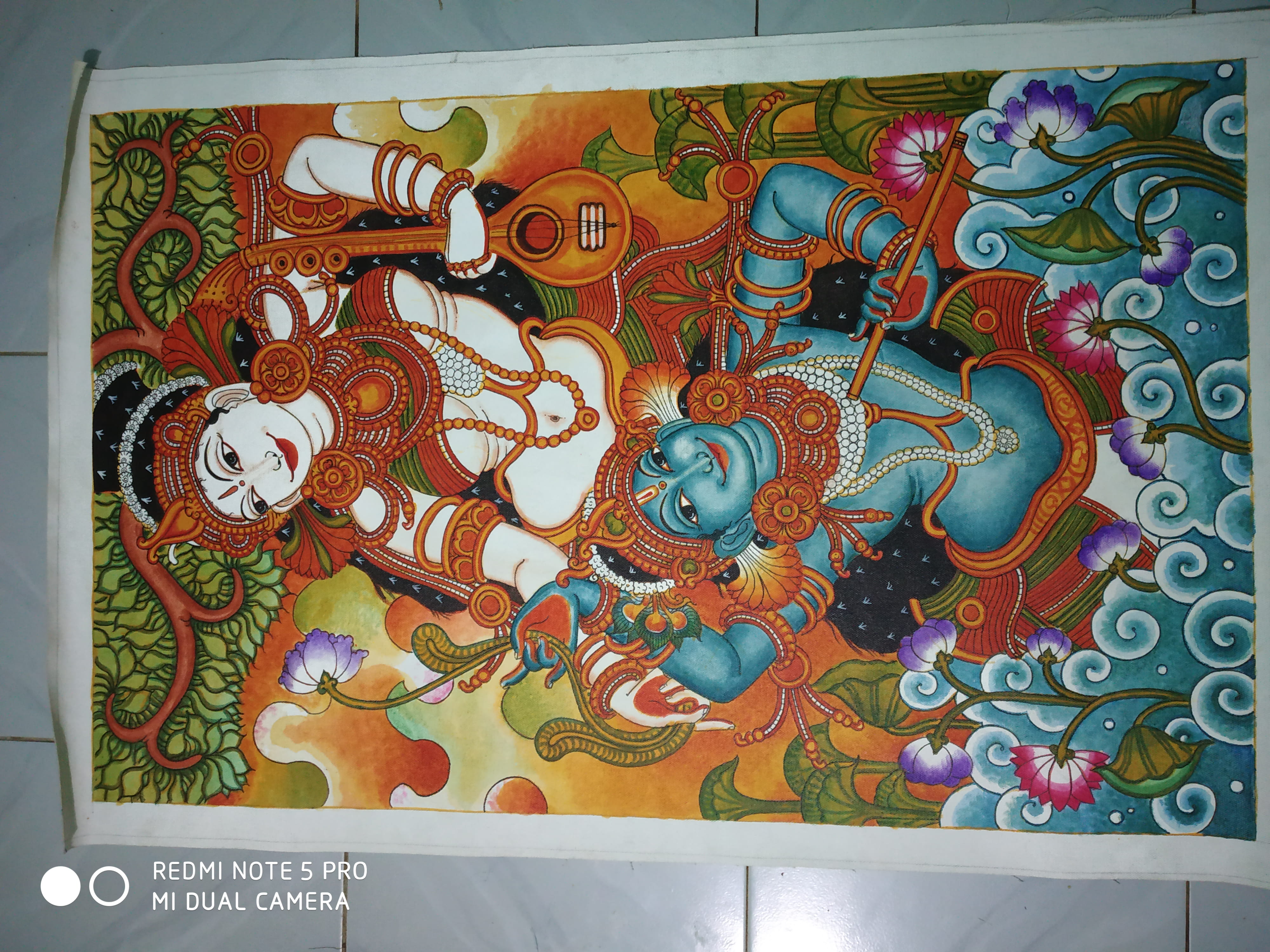
(Note: The image is sideways, but it captures a stunning depiction of Lord Krishna playing his flute alongside a female companion holding a stringed musical instrument amidst lotuses and waves.)
Title
Melodies of the Soul: The Musical Devotion of Radha and Krishna in Mural Art
Excerpt
Delve into the intricate symbolism and rhythmic grace of a classic Kerala mural painting depicting the divine romance of Radha and Krishna through celestial music.
Category
Mural Painting
Content
INTRODUCTION
The depiction of Lord Krishna alongside his beloved Radha remains one of the most spiritually resonant themes in Indian classical art. In IMG_20181120_174805.jpg, this celestial companionship is elegantly adapted onto canvas following the strict stylistic guidelines of traditional Kerala murals. The scene vibrates with artistic and musical harmony as a deep blue-hued Krishna holds his flute, accompanied by a companion cradling a beautifully detailed stringed instrument. Set against an background of churning water, blooming lotuses, and dense foliage, the painting creates a poetic visual sanctuary
The Panchavarna Balance and Aquatic Motifs
This artwork wonderfully showcases the traditional color hierarchy of Kerala's heritage art. Lord Krishna is rendered in a calm, majestic cerulean blue skin tone, while his companion is depicted in a brilliant white skin tone that highlights her graceful posture. Their heavy, intricate necklaces, armlets, and crowns are painstakingly shaded using the characteristic stippling (dot-shading) technique with warm orange and saffron hues. The right side of the canvas features highly stylized, curling blue and white waves packed with vibrant pink and violet lotuses, showcasing the mural tradition's profound talent for turning natural elements into rhythmic, decorative masterpieces.
"Art is not what you see, but what you make others see. The mural paintings of Kerala are a testament to this profound truth."
Share this article
Back to Magazine